On Israeli campuses, the state marks another enemy within
As the occupation's mechanisms of control seep into the civilian sphere, Jewish dissidents are next in line — and academic freedom offers no protection.
In the Israel of 2025, the boundaries between the regime’s arenas of power are becoming blurred. The mechanisms of domination over Palestinians in the occupied West Bank and Gaza — military law alongside civil law, unrestrained power beside formal institutions — seep inward to affect Palestinian citizens of Israel and, increasingly, Jewish-Israeli dissidents who refuse to fall in line with state policy.
This is no sudden shift, but rather a cumulative process. Over decades, the occupation regime developed technologies of control, surveillance, and classification to subjugate Palestinians, which have gradually turned into instruments of governance within Israel’s civilian sphere.
A central part of this is the mechanism of marking enemies. This is not just a practice of military control but a broad political tool that redefines the limits of legitimacy. In this regard, two recent attacks on freedom of _expression_ at Israeli university campuses are therefore not exceptions; they are the natural continuation of long-constructed patterns.
On Nov. 6, Alec Yefremov, who teaches civics at a Tel Aviv high school, attended his sister’s graduation ceremony at the Hebrew University of Jerusalem. Also in attendance, celebrating his wife’s degree, was National Security Minister Itamar Ben Gvir. Upon spotting the leader of the Otzma Yehudit (Jewish Power) Party, Yefremov shouted that he is a racist, a Kahanist, and that he idolizes Baruch Goldstein, who gunned down 29 Palestinians in Hebron’s Ibrahimi Mosque in 1994.
Yefremov was ejected from the ceremony by university security guards before being handcuffed by police and taken away for interrogation on suspicion of “insulting a public servant” and “disturbing public order.” He was strip searched at the police station, and later released with a 15-day ban from the university campus.
The Hebrew University released a statement condemning Yefremov’s arrest, and the Israel Police, under pressure from opposition politicians, launched an internal investigation into the arrest and strip search. (Such investigations routinely come to nothing.)
A week later, Almog Cohen, a deputy minister in the Israeli Prime Minister’s Office, stormed into a lecture at Ben-Gurion University of the Negev in the southern city of Be’er Sheva. Armed with immunity and a sense of ownership over the space, Cohen — joined by activists from the far-right Im Tirzu movement, who filmed him and put the video online — came to disrupt a computer science lecture by Sebastian Ben Daniel, a regular critic of Israeli policy (and a long-time contributor to +972 under the pen name John Brown).
“I came this morning to Ben-Gurion University due to the lecturer Sebastian Ben Daniel’s antisemitic remarks, who called the IDF’s heroic soldiers ‘baby murderers, war criminals, neo‑Nazis,’” Cohen said later in a statement. “I will not allow someone who is paid with public funds to express himself this way when many of his students — on the right or the left — are reservists themselves.”
The university filed a police complaint against Cohen, and said in a statement: “Our campuses must remain safe for studies, teaching, research, and the exchange of ideas, [and be] places where students can learn and be educated, lecturers can teach, and researchers can conduct research without fear of physical or verbal violence.”
While by no means identical, these two incidents are expressions of the same phenomenon. They illustrate the erosion of the boundary between legitimate authority and raw power — even within the Green Line, and even directed against Jews.
Naked authority
In an academic article I wrote a decade ago, titled “On the Objective Enemy and the Political Void,” I showed how a denunciation mechanism operates in Israel whereby a threat is defined not based on any action or evidence, but merely by labeling it as such. A hint, a word, an Instagram story, or sometimes even silence is enough to place someone into an “enemy” category measured solely by images, perceptions, and the emotions they trigger, eliminating the need for proof.
This has long been the reality in the occupied territories: Palestinians are defined as naturally suspicious, and the law is crafted accordingly. But once enemy-marking becomes a central tool of governance, it perpetually seeks new targets.
In recent years, Palestinian citizens of Israel have gradually been incorporated into this definition, facing indictments for social media posts, restrictions on free speech, and police interrogations for public statements. Now, Jewish opponents of the regime — including critical lecturers and politically active students — find themselves falling victim to the same mechanism.
This situation can also be understood through what the German-Jewish political scientist Ernst Fraenkel termed concept of the “dual state,” a condition where the state operates two systems simultaneously: a normative one that speaks the language of laws, procedures, and regulations; and alongside it, a prerogative system that acts with naked authority in the name of “security,” “national interest,” or “public order.”
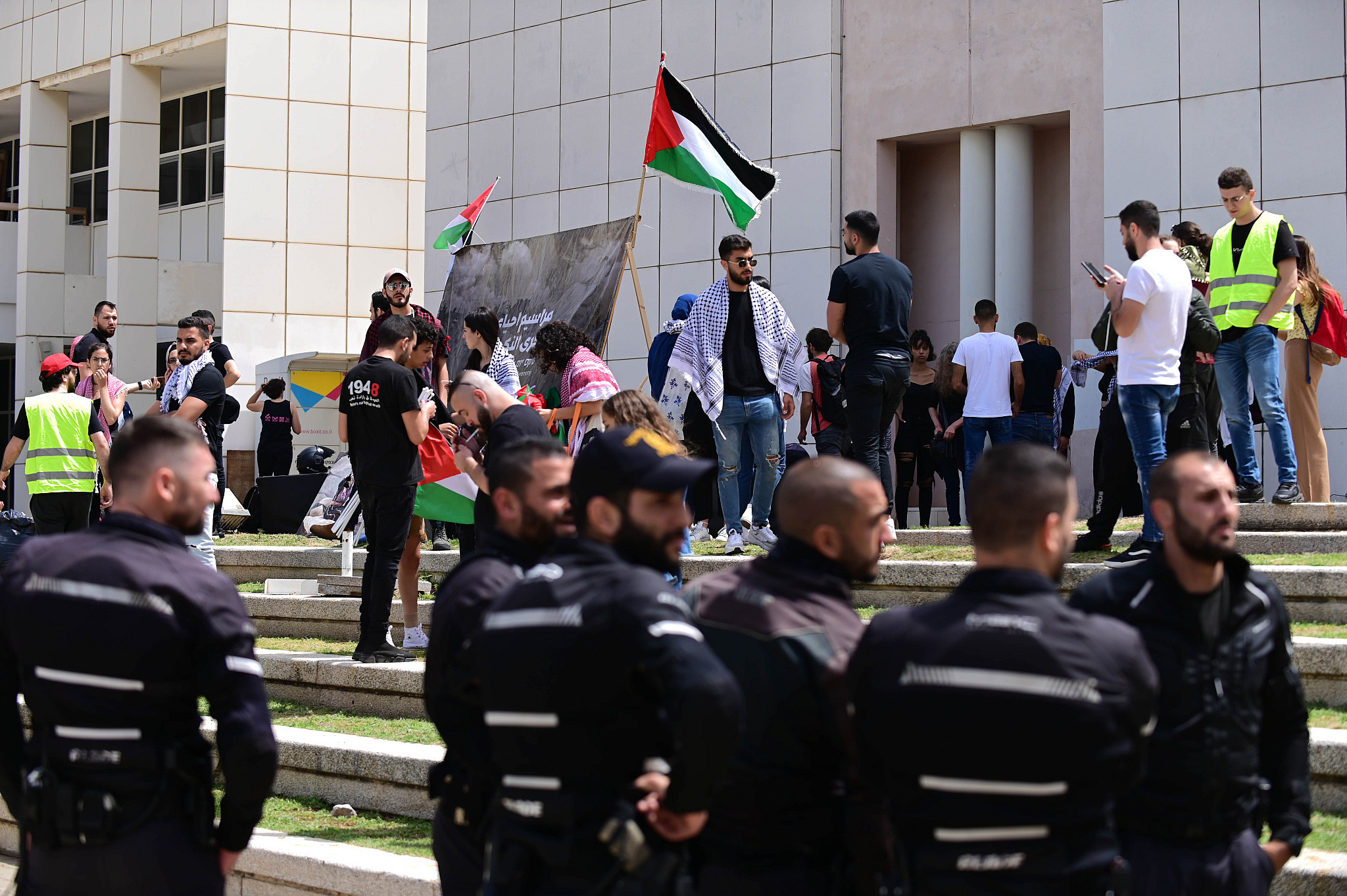
Police watch on as Palestinian and left-wing Israeli students hold a Nakba Day rally at Tel Aviv University, May 15, 2022. (Tomer Neuberg/Flash90)
The arrest of Yefremov and the storming of Ben Daniel’s lecture are allegories that illustrate this mechanism: If the former is disguised by a facade of legality and administrative procedure, the latter exposes the regime’s raw, immediate, disproportionate force.
The academic sphere is supposed to be protected by the principle of freedom of intellectual inquiry, which has allready severely eroded, yet the prerogative arm of political power enters it unimpeded. The model long used in the occupied territories — military law alongside civil law, unrestrained power beside formal institutions — now seeps inward almost without resistance. And when both systems operate in tandem, the distinction between “legal” and “permissible” collapses.
When control, surveillance, and the rhetoric of the “internal enemy” turn into tools of civilian management, there is no ceiling: Yesterday’s external enemy becomes tomorrow’s internal one. Once this logic is internalized by the police, politicians, and members of the academic institutions themselves, what we witness on campuses is not “escalation” but a direct demonstration of the system at work.
When order is the problem
The responses to these two incidents speak in the same coded language. The statement by the Association of University Heads, which condemned Cohen’s intrusion into the Ben-Gurion University lecture theater and called for preserving safe learning spaces, may have sounded harsh, but it avoided confronting the mechanism that produces the violence.
It spoke of “zero tolerance for disorder,” as if the problem lay in unruly conduct rather than in a political regime wielding unrestrained power over spaces of knowledge. It appealed to the government to condemn the act, as though this were not the very government that marks lecturers as enemies and enables the incursion of the prerogative arm into the academic sphere. Thus, institutions’ ability to set boundaries is eroded: They adopt the regime’s language rather than challenging it.
The former university presidents and Nobel laureates’ response was sharper and more precise, yet still confined within a liberal paradigm that calls upon weakened institutions to defend themselves. It voiced deep concern for freedom of _expression_ and civic resilience but failed to recognize that the normative system itself can no longer contain the reach of the prerogative arm. And it, too, called for a “restoration of order” — a futile demand when an institution must defend itself against a political force that holds the mechanism for enemy-marking. Order itself is the problem.
What has unfolded on Israeli campuses, then, is not simply an “attack on academic freedom,” but the exposure of this mechanism on full display. The police did not deviate from their path when using disproportionate force against Yefremov; they acted according to a model long tested on Palestinians. Cohen did not barge into a lecture theater because he was “unrestrained”; he did it because the Israeli regime has signaled to him that the academic sphere is no longer protected.
When academia itself adopts the language of order, security, and patriotism, it can no longer articulate an effective opposition to state power, and instead cedes authority and legitimacy back to the state. And there is no point in asking the regime to stop seeing us as enemies, because a mechanism that produces enemies needs them to justify its existence.
The only possible response is political: to bring the language of power, control, race, and regime back to the center; to rebuild spaces of knowledge and community independent of state approval; to expose the mechanism of enemy-marking; and to form Jewish-Palestinian partnerships that dismantle the very conditions necessary for this mechanism to operate.
A version of this article was first published in Hebrew on Local Call. Read it here.